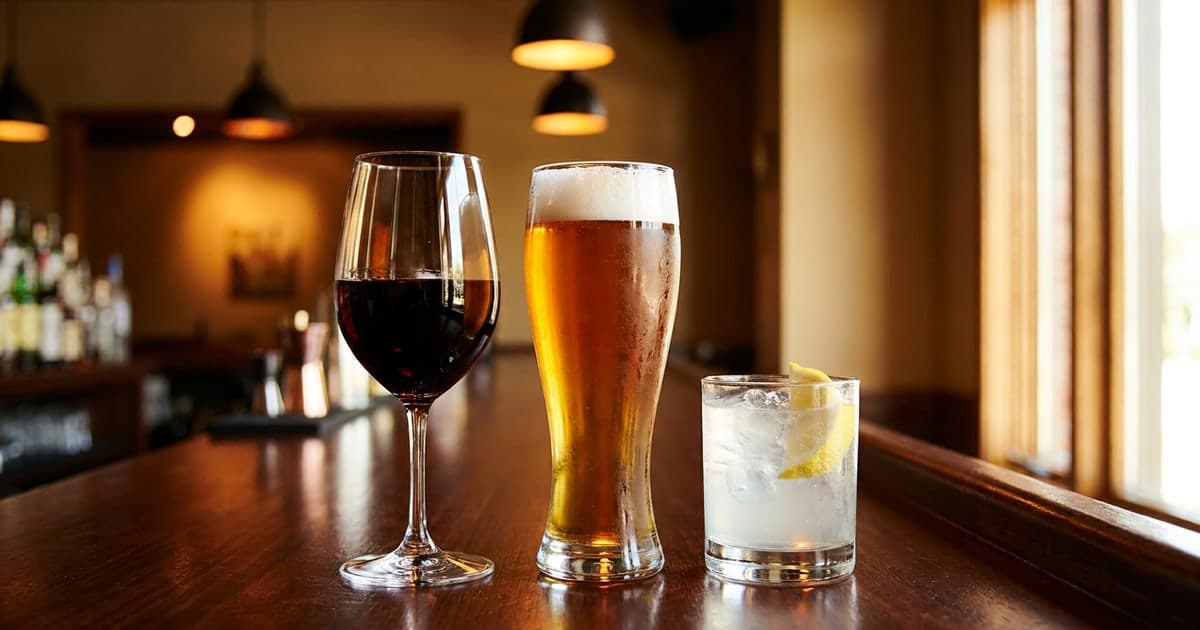
How to Track Alcohol Calories: Beer, Wine, Cocktails, and Spirits
Alcohol is the macronutrient nobody talks about. It packs 7 calories per gram — higher than carbs (4), just below fat (9) — and unlike any of those, it doesn't trigger satiety, doesn't contribute to muscle, and quietly disappears from most food logs. If your weight has stalled and you drink more than twice a week, ethanol is probably the variable you haven't accounted for.
This isn't an anti-drinking article. It's a tracking article for people who plan to keep drinking and want their numbers to be honest.
Why alcohol breaks calorie math
Most people log alcohol the way they log food: imprecisely, and usually after the fact. That's where the problem starts. There are three structural reasons alcohol is harder to track than anything else you eat.
First, your liver treats it as a threat. Ethanol is technically toxic, so when it shows up, your liver shifts almost all of its metabolic resources toward oxidizing it. Research from the late 1990s and early 2000s using indirect calorimetry showed that fat oxidation drops by roughly 70–75% during and after moderate drinking, and the suppression can last 12–18 hours after a typical session. Translation: a Friday night out doesn't just add Friday's calories — it pauses fat loss into Saturday.
Second, alcohol has zero satiety signaling. No protein, no fat, no fiber, almost no water-volume effect. Your body doesn't release leptin or CCK in response to it. You can drink 600 kcal in 90 minutes and feel hungrier than when you started.
Third, self-report is wildly unreliable. A "glass of wine" at home is rarely the 5 oz the database lists — it's usually 6–8 oz. A "pint" of beer can be anywhere from 16 to 22 oz depending on the venue. Cocktails are essentially un-trackable without seeing the recipe.
This pattern shows up everywhere: see why most people fail at calorie counting and hidden calories in everyday foods for the same problem in food form.
Beer: calories by category
Beer calories scale almost linearly with ABV. The strong rule of thumb: higher alcohol = higher calories, with carbs adding a secondary load. Below are realistic 12 oz (355 ml) values.
| Beer type | ABV | Calories (12 oz) |
|---|---|---|
| Light lager (Bud Light, Michelob Ultra) | 4.0–4.2% | 95–110 |
| Regular lager (Bud, Heineken, Stella) | 5.0% | 140–170 |
| IPA | 6–7% | 200–250 |
| Imperial / Double IPA | 8–10% | 280–380 |
| Stout (Guinness, 12 oz) | 4.2% | 130 |
| Hard seltzer (5%) | 5.0% | 95–110 |
Two things to notice. A craft IPA is roughly two light beers in one glass — easy to forget when the pour size is the same. And Guinness, despite its reputation as a "heavy" beer, is actually one of the lighter mainstream options because of its low ABV.
If you're drinking out of a 16 oz pint glass instead of a 12 oz bottle, multiply by 1.33. A pint of IPA is closer to 300 kcal than 200.
Wine: the 5 oz fiction
The standard wine pour by USDA definition is 5 oz (about 150 ml). Almost nobody pours that at home. A "normal glass" at a restaurant is typically 6 oz; at home it's frequently 8 oz. Adjust accordingly.
| Wine type | Calories per 5 oz |
|---|---|
| Dry red (Cabernet, Pinot Noir, Malbec) | 120–130 |
| Dry white (Sauvignon Blanc, Chardonnay) | 115–125 |
| Sparkling brut (Champagne, Prosecco) | 95–115 |
| Dessert wine (port, ice wine, Sauternes) | 165–230 per 3 oz |
Dry wines cluster tightly around 120 kcal per 5 oz. The variable that actually changes your numbers is pour size, not grape. If you typically pour 7 oz, your "glass" is more like 170 kcal. A bottle is 5 standard pours, which means finishing a bottle solo is roughly 600 kcal — equivalent to a full restaurant meal with no food in it.
Dessert wines are a different animal: high residual sugar plus high alcohol pushes them into 200+ kcal territory in a small 3 oz pour.
Spirits and cocktails: where the damage is
Neat spirits are surprisingly efficient. A 1.5 oz shot of vodka, gin, whiskey, tequila, or rum is roughly 95–110 kcal — about the same as a light beer. The problem is almost never the alcohol itself. It's the mixer.
| Drink | Calories |
|---|---|
| Vodka/gin/whiskey/tequila/rum (1.5 oz neat) | 95–110 |
| Vodka soda (any reasonable size) | 95–105 |
| Gin & tonic (regular tonic) | 170–200 |
| Old Fashioned | 160–180 |
| Margarita (typical, shaken) | 280–350 |
| Frozen margarita | 500+ |
| Mojito | 220–260 |
| Espresso martini | 220–280 |
| Pina colada | 500–650 |
| Long Island Iced Tea | 500–700 |
Tonic water has 130 kcal per cup. It's basically sugar water with quinine. A gin & tonic is a vodka soda plus a soda. Margaritas combine 2 oz tequila, 1 oz triple sec (sugar liqueur), and sour mix or simple syrup — the mixer can be 70% of the total calories. Frozen versions add a cup of slushy syrup on top.
Long Island Iced Tea remains the single worst cocktail per glass: five spirits plus sweet & sour plus cola. It's a meal.
The mixer trap
If you ordered the same cocktail with diet mixers, you'd often save 80–150 kcal per drink. Across four drinks, that's an entire restaurant entrée's worth of calories — gone, with no taste hit beyond the mixer difference.
The quick swap list:
- Tonic to soda water: saves ~120 kcal
- Coke to Diet Coke: saves ~95 kcal
- Simple syrup cocktails to spirit + soda: saves 150–300 kcal
- Margarita to tequila soda with lime: saves 200+ kcal
- Mojito to white rum, lime, soda, mint: saves ~150 kcal
If you cover this territory more broadly, liquid calories has the wider picture on what drinkable calories do to a deficit.
The drunk eating surplus
The cruelest part of alcohol math: the drinks themselves are usually not what breaks the deficit. The 2 a.m. food does.
Alcohol lowers inhibition, blunts the leptin response, and increases reward sensitivity to high-fat, high-salt food. Across the population, late-night post-drinking eating routinely adds 500–1,000 kcal on top of the drinks. A taco truck stop, a slice of pizza on the way home, a kebab, a bag of chips at 1 a.m. — these are the calories that turn "I had four beers" into "I ate 2,200 calories after dinner."
If you're going to drink and you care about your numbers, defending the post-drink window is more important than picking the right beer. This is also a leading cause of an unexplained weight loss plateau: a single drinking night per week, with post-drink eating, can erase a 500 kcal/day deficit for the entire week.
Health Score: alcohol scores poorly
Across any sensible nutrition framework, alcoholic drinks score badly. They contain zero protein, zero fat, zero fiber, negligible micronutrients (a small polyphenol argument for red wine notwithstanding), and 7 kcal/gram of a substance your body classifies as a toxin. From a satiety-per-calorie perspective, this is the worst possible profile. From the Calzy Health Score perspective, most alcoholic drinks land in the D–E range regardless of brand.
That's not a moral judgment — it's a mechanical one. The drink doesn't help you reach protein targets, doesn't help with fiber, doesn't keep you full, and pauses fat oxidation while it's metabolized. Tracking it accurately is the only way to make it fit anyway.
Drinking on a cut: the honest math
Say your cut target is 1,700 kcal/day. Here's what that looks like with alcohol:
- One 12 oz light beer: 100 kcal (6% of the day) — fine
- Two glasses of dry wine at 6 oz each: ~300 kcal (18%) — workable
- Three margaritas: ~900 kcal (53%) — possible but tactically painful
- A bottle of wine alone: ~600 kcal (35%) — leaves ~1,100 kcal for food
- Four IPAs: ~900 kcal (53%) — same as the margaritas
It's mathematically possible to drink on a cut. It's also possible to lose weight eating exclusively at McDonald's. The question isn't possible, it's sustainable while hitting protein, fiber, and satiety.
The practical rule from the data: 1–2 drinks per week with food fits a cut without measurable issue. 5+ drinks per week is usually enough to explain a stall by itself — between the calories, the fat oxidation pause, and the late-night eating.
For context on what else stalls fat loss when calories look right on paper, see why not losing weight in a calorie deficit.
How to actually track this with Calzy
Two paths, depending on where you're drinking:
At home (bottles and cans): scan the barcode. The Calzy database covers 300,000+ products, including most beer, wine, hard seltzer, and ready-to-drink cocktails. The label calories are accurate to the volume listed — adjust if you're pouring more than the serving size.
At a bar (mixed drinks): photo AI is your best option. Snap the drink, log the approximate calories from the recognition. For known cocktails (margarita, mojito, Old Fashioned), the AI handles it in ~3 seconds. For house specials with unknown recipes, default to the closest match and round up — under-logging cocktails is the most common alcohol tracking error.
For restaurant calorie tracking more broadly, the same principle applies: when in doubt, round up.
The pre-night protocol
Five steps, applied before you leave the house, that turn a drinking night from a guess into a managed number:
- Set a drink budget in calories, not drinks. Decide before you leave: "Tonight I have 400 kcal for alcohol." That's four light beers, three glasses of dry wine, or one and a half margaritas. Pick which currency you're spending it in.
- Pre-log the drinks at the start of the night. Add them to Calzy before the first sip. If your plan is three vodka sodas, log three vodka sodas now. End-of-night logging is when calorie counting mistakes compound — you don't remember the fourth drink.
- Eat a protein-and-fiber-heavy meal before drinking. 35–45 g protein, plenty of vegetables. This blunts insulin response, slows alcohol absorption, raises satiety, and dramatically reduces the odds of late-night eating. This single step does more for the night's calorie math than any drink swap.
- Default to high-efficiency drinks if you want to maximize drinks per kcal. Vodka soda, dry wine, light beer, hard seltzer. You can have 4–5 of these in the calorie budget of 2 margaritas.
- Skip the post-drink food. Have a glass of water and a small protein snack at home if you're genuinely hungry. The 2 a.m. taco is where the real damage compounds — and it's the easiest single calorie source to remove from the entire night.
Bottom line
Alcohol is trackable. It's also unforgiving: high calorie density, no satiety, no nutritional payload, and a multi-hour pause on fat oxidation. None of that means you have to quit. It means the numbers have to be honest.
Set the budget before you leave. Pre-log the drinks. Eat real food first. Pick efficient drinks if volume matters to you. Defend the late-night window. That's the whole protocol — and for the average social drinker, it's the difference between a cut that works and a cut that mysteriously doesn't.
Ready to track smarter?
Snap a photo, get your calories, macros, and Health Score instantly. See what other trackers miss.
Download Calzy — It's Free