Intuitive Eating vs Calorie Counting: Which Actually Works for Weight Loss?
The internet has turned this into a tribal war. One camp insists calorie counting is the only thing that works; the other treats any form of tracking as disordered eating. Both camps are partly right, and both are talking past each other because they answer different questions.
This piece is going to do something neither side does often: compare intuitive eating vs calorie counting on what the research actually shows, and then tell you which one fits your situation. Because the honest answer is that they solve different problems, and picking the wrong tool is the reason most people fail at both.
What Intuitive Eating Actually Is
Intuitive eating gets misused constantly. It is not "eating whatever you want," and it is not a back-door weight-loss method dressed up in body-positive language. It is a specific framework developed by dietitians Evelyn Tribole and Elyse Resch in their 1995 book, built around ten principles that include:
- Reject the diet mentality
- Honor your hunger
- Make peace with food (no forbidden categories)
- Challenge the food police (internalized rules around "good" and "bad" foods)
- Discover the satisfaction factor
- Respect your fullness
- Cope with emotions without using food
- Respect your body
- Movement (feel the difference)
- Honor your health with gentle nutrition
Read those carefully. Weight loss is not on the list. That is not an accident. Intuitive eating was designed as a recovery-oriented, non-diet approach for people whose relationship with food had been damaged by chronic dieting. It is a mental-health and behavior framework first, and any weight outcome is incidental.
This matters because most people Googling "intuitive eating" are actually looking for permission to lose weight without tracking. That is a different goal, and the framework was not built to deliver it.
What Calorie Counting Actually Is
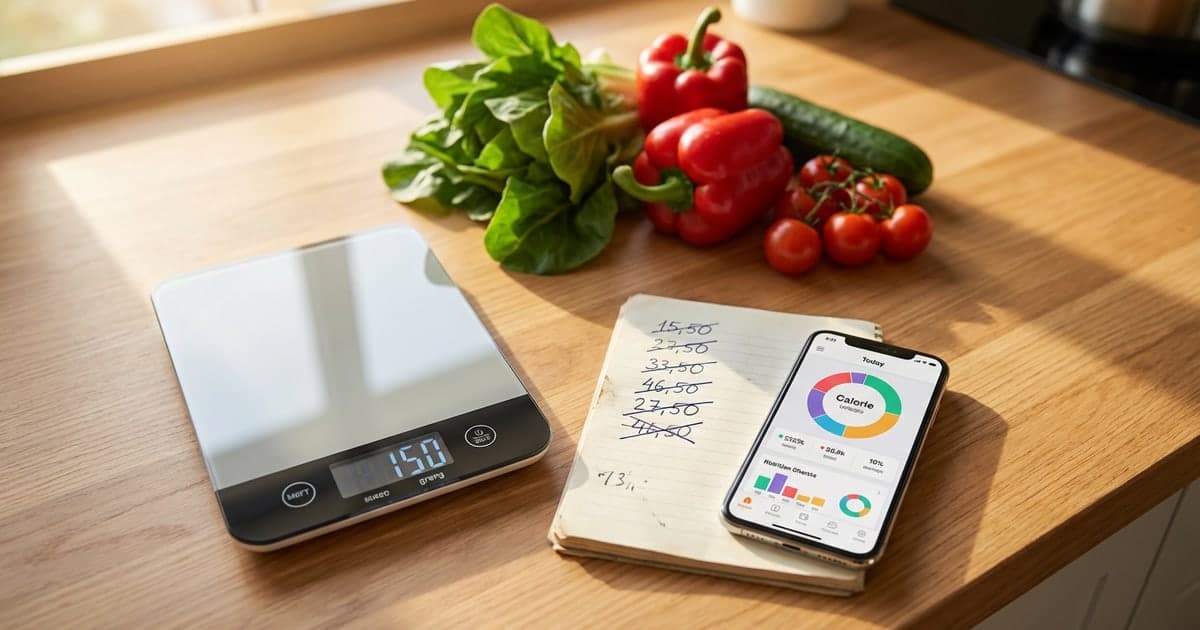
Calorie counting is structured tracking against an explicit numerical target. You estimate your maintenance calories (roughly 14–16 kcal per pound of body weight, depending on activity), subtract 300–700 kcal for a moderate deficit, and log what you eat against that target.
The goal is explicit and measurable: you are creating a known energy gap and verifying it with data. That is a fundamentally different mental posture than intuitive eating. It treats the body as a system that responds to inputs, and it treats your perception of hunger and fullness as useful but not reliable enough to drive the entire process unsupervised.
If you want a longer breakdown of where this approach goes wrong, here are the most common calorie counting mistakes — most of them are about poor estimation, not the method itself.
What the Research Actually Shows
This is where things get interesting, because the two methods are usually evaluated against different endpoints.
Intuitive Eating: Strong on Mental Health, Neutral on Weight
A consistent finding across roughly 100 studies over the last two decades is that intuitive eating is associated with:
- Lower binge eating frequency
- Lower disordered eating scores
- Better body image and self-esteem
- Better psychological well-being
- More stable eating patterns over time
What the same body of research shows on weight: basically nothing. Randomized controlled trials comparing intuitive eating to standard care or to active weight-loss interventions consistently find no significant weight loss in the intuitive-eating arm. A few trials show small weight maintenance benefits versus regain after a diet, but that is a maintenance finding, not a weight-loss finding.
Intuitive eating proponents respond — fairly — that this is exactly the point. The framework was never about weight loss. Holding it to that standard is like criticizing a meditation app for not lowering your blood pressure: it might, but that is not its job.
Calorie Counting: Strong on Short-Term Weight Loss, Weak on Long-Term Adherence
Large meta-analyses of structured calorie-tracking interventions show a fairly stable result: when adhered to for 6–12 months, participants lose 5–10% of starting body weight on average. That is a clinically meaningful number — enough to improve insulin sensitivity, blood pressure, and joint loading.
The problem is what happens after.
- 3-year regain rate: approaching 100% of weight lost without continued behavior change
- App abandonment: roughly 70% of new tracking-app users stop within 3 months
- Self-reported reasons for quitting: tedium, social friction, anxiety around numbers, perfectionism cycles
We covered the dropout side of this in detail in why most people fail at calorie counting. The takeaway: calorie counting works when it is done. It is rarely done long enough.
A Direct Comparison
| Dimension | Calorie Counting | Intuitive Eating |
|---|---|---|
| Designed for | Weight loss, body composition | Repairing food relationship, non-diet living |
| Average 6-month weight loss | 5–10% of body weight | No significant change |
| Mental-health profile | Mixed; can increase food anxiety | Consistently improved across studies |
| Binge-eating risk | Can rise with restriction mindset | Reliably drops |
| Time cost (manual logging) | 15–30 min/day | Effectively zero |
| Time cost (photo logging) | 2–5 min/day | Effectively zero |
| Learning curve | High initially (portion sizes, label reading) | Moderate (interoceptive awareness takes practice) |
| Best for body recomposition | Yes | No |
| Best for post-eating-disorder | No (often contraindicated) | Yes |
| Sustainable long-term as-is | Rarely | Often |
The table makes the point clearer than most articles do: these methods are not interchangeable. They are answering different questions.
When Intuitive Eating Is the Right Tool
Pick intuitive eating, or something close to it, if you fit one of these:
- You're in recovery from an eating disorder or have a clinical history of one. Tracking is contraindicated in most clinical guidelines for active or recent ED recovery. Work with a registered dietitian who specializes in this.
- You're a chronic dieter with five-plus failed attempts. If structured tracking has produced anxiety, perfectionism cycles, or rebound eating multiple times, doing the same thing harder is not the answer.
- You're at a healthy weight already and want to maintain. Maintenance is the phase where intuitive eating shines, especially after you have learned portion baselines from a previous tracking period.
- Tracking creates anxiety or obsession for you. Some people get pulled into a perfectionism spiral by numbers. If that is you, the method is doing more harm than good regardless of the weight outcome.
- You're an athlete with good hunger signaling. Athletes who train consistently and eat to recover often self-regulate well from hunger cues. Many do not need to track outside specific goal phases.
In all of these cases, the win condition is not weight loss. It is a stable, low-friction relationship with food that supports the rest of your life.
When Calorie Counting Is the Right Tool
Pick calorie counting, or some structured tracking method, if you fit one of these:
- Meaningful weight loss is the actual goal. Not "I want to feel better about my body" — that is a different problem. If you specifically want to drop a clinically meaningful amount of fat mass, the evidence base for structured tracking is far stronger than for any non-diet approach.
- Body recomposition or physique sport. Bodybuilding, physique categories, weight-class athletics. You need numerical control.
- You have low interoceptive awareness. Some people genuinely cannot read their hunger and fullness reliably. Common in people who grew up using food for emotional regulation, in shift workers, in people on certain medications. Intuitive cues are noisy for you.
- You're learning portion sizes for the first time. This is the underrated use case. Most adults have never seen what an actual 4-oz serving of chicken looks like. Tracking for even 8 weeks teaches portion calibration that lasts decades.
- You suspect hidden calories are inflating your intake. Cooking oils, dressings, condiments, drinks. These almost always require numerical verification to catch.
The decision rule here is honest: if your goal is fat loss in someone above their setpoint, intuitive eating rarely delivers it. Saying otherwise is wishful thinking.
The Honest Middle: Most "Intuitive Eaters" Who Lose Weight Are Doing Something Else
This is the part that gets left out of nearly every article on this topic.
Many people who say they "just eat intuitively" while maintaining or losing weight are actually doing low-effort approximate tracking by visual portion recognition. They learned what 600 calories looks like on a plate during a tracking phase years ago, and now they eyeball it. They are not running on pure hunger cues; they are running on a calibrated visual model.
That is a legitimate and effective approach. But it is not the same thing as someone who has never tracked, has no portion baseline, and is told to just listen to their body. That person, if already above their setpoint, usually does not lose weight. Their body's hunger and fullness signals are calibrated to maintain the current weight — that is what those signals exist to do.
Pure intuitive eating with no prior tracking foundation almost never produces weight loss in adults already past their setpoint. The body's homeostatic system is doing its job, and that job is not to make you smaller.
The Hybrid Model: The Sustainable Path Most People Miss
The honest synthesis, and what most experienced dietitians actually recommend, looks like this:
- Track structured for 8–12 weeks. Long enough to build portion-size intuition, identify your personal hidden-calorie traps, and verify whether your "small" snacks were actually small.
- Step down to spot-checking. Track 2–3 days a week, or only one meal a day, or only weekends.
- Transition to intuitive eating in maintenance. Once you hit your goal weight or hit a stable rhythm, drop the numbers and rely on the visual baseline you built.
- Return to tracking briefly if you drift. Two to three weeks of tracking after a holiday or stressful period is enough to recalibrate without becoming a permanent habit.
This is the model that produces both the weight outcomes of calorie counting and the mental-health outcomes of intuitive eating. It is also the model that survives life — because no one tracks every meal forever, and any plan that requires it is doomed.
If you have stalled mid-process and are not sure why, this breakdown of plateau causes covers what usually goes wrong in the transition.
Where Photo-Based Tracking Fits
The main reason people abandon the tracking phase of the hybrid model is friction. Manual entry takes 15–30 minutes a day, every day, with a steep learning curve on portion estimation and label reading. Most people do not last 12 weeks at that level of effort.
Photo-based tools collapse the time cost. Snapping a meal photo takes about 3 seconds, and a tool like Calzy identifies the foods and estimates portions automatically. You still verify, but the floor for engagement is much lower. That makes the 8–12-week learning phase achievable for people who would otherwise quit in week two. We went deeper on the mechanics in why photo logging tends to beat manual entry.
The point is not to track forever. The point is to track long enough to learn what your real intake looks like, then move on.
A Decision Rule You Can Actually Use
Stop debating this in the abstract. Walk yourself through these questions:
- Have you tracked for 8+ weeks before?
- No → Start with structured tracking. You need the portion baseline. Pure intuitive eating without it rarely works for weight loss in adults.
- Yes → Go to question 2.
- Did tracking create anxiety, obsession, or perfectionism cycles for you?
- Yes → Move toward intuitive eating, ideally with support from a non-diet RD. Your win condition is a calmer relationship with food, not a smaller number.
- No → Go to question 3.
- Are you currently at a healthy weight?
- Yes → Use the hybrid model. Default to intuitive eating, spot-check with tracking 1–2 days a week or after life disruptions.
- No → Return to structured tracking for 8–12 weeks, then transition.
- Do you have a history of an eating disorder?
- Yes, currently or recently → Do not self-direct this. Work with a clinician. Tracking is often contraindicated.
- No → Follow your answer from question 3.
That is the framework. It is not glamorous, but it is honest, and it routes the right people to the right tool instead of asking everyone to fight over which method is the winner.
There is no winner. There is what fits your goal, your history, and your psychology. Pick accordingly.
Ready to track smarter?
Snap a photo, get your calories, macros, and Health Score instantly. See what other trackers miss.
Download Calzy — It's Free