Walking for Weight Loss: How Many Steps Actually Matter?
The 10,000-step target you have been chasing since you got your first Fitbit is not based on a single study. It was a 1960s pedometer slogan. The actual research points somewhere lower — and walking, the most boring form of cardio, quietly outperforms running for most people trying to lose fat.
This is the long-form breakdown: where the numbers come from, what they actually do to your body, and how to use them.
Where the 10,000-step number actually came from
In 1965, a Japanese company called Yamasa launched a pedometer for the Tokyo Olympics era fitness boom. They named it manpo-kei — literally "10,000 steps meter." The number was chosen because the Japanese character for 10,000 vaguely resembles a walking person, and because it was a memorable round figure. That is the entire origin story.
There was no clinical trial. No physiologist sat down and calculated optimal daily ambulation. A marketing team picked a number that sold pedometers. Sixty years later, half the planet still treats it as gospel.
This matters because the real research tells a different story.
What the actual research says
A large 2023 meta-analysis pooled data from hundreds of thousands of participants across multiple cohorts. The findings were specific:
- Adults over 60: mortality risk drops sharply up to roughly 7,000 steps per day. Beyond that, the curve flattens.
- Adults under 60: the inflection sits closer to 8,000–10,000 steps, with diminishing returns after.
- Even modest increases — going from 3,000 to 5,000 steps daily — produced meaningful cardiovascular and metabolic improvements.
The key word is diminishing. Going from 4,000 to 7,000 steps gives you most of the benefit. Going from 10,000 to 15,000 gives you a much smaller marginal return on longevity. For weight loss specifically, more steps still equal more calories — but for general health, you do not need to hit five digits.
The calorie math, honestly
A 70 kg adult burns roughly 0.04–0.05 kcal per step at a normal walking pace. That gives us:
| Steps/day | Daily calorie burn (70 kg adult) | Annual fat-loss equivalent | Best for whom |
|---|---|---|---|
| 3,000 | ~120 kcal | Negligible | Desk-job default |
| 5,000 | ~200 kcal | ~9 kg/year | Beginner target |
| 7,000 | ~280 kcal | ~13 kg/year | Research-derived sweet spot |
| 10,000 | ~400 kcal | ~18 kg/year | Active adults |
| 12,500+ | ~500+ kcal | ~22+ kg/year | Fat-loss accelerator |
A few caveats. These are estimates. Pace, terrain, body weight, and individual efficiency all shift the number. A heavier person burns more per step. Hills add 20–40%. Brisk walking adds maybe 10–15% over a stroll.
But the structural point holds. Walk 10,000 steps every day for a month and you have spent roughly 14,000–17,500 kcal. At the theoretical 7,700 kcal-per-kilo-of-fat equivalence, that is about 1.6–2 kg of fat loss per month — assuming you do not eat it back. Which is the entire catch, and we will return to it.
Why walking beats running for weight loss
This is counterintuitive. Running burns more calories per minute. Surely it is better?
For elite athletes and people who genuinely love running — yes. For everyone else trying to lose fat sustainably, walking wins on at least five fronts.
1. Lower cortisol response. High-intensity work spikes cortisol. Chronic cortisol elevation can encourage visceral fat retention and disrupt recovery. Walking is glycemically and hormonally gentle.
2. No compensatory hunger. Intense cardio drives appetite up disproportionately. This is well documented in metabolic research from the 2010s — people often eat back 60–90% of the calories burned during hard cardio without realizing it. Walking does not trigger this compensation nearly as strongly. The deficit you create tends to stick.
3. Fat oxidation peaks at lower intensities. Your body burns the highest proportion of fat (as opposed to glycogen) at around 50–65% of maximum heart rate — which is roughly a brisk walk. Running typically pushes you above this zone, where the substrate shifts toward carbohydrate.
4. Sustainability. Look at gym memberships in February versus January. People quit running. People quit HIIT. Almost nobody quits walking, because walking does not feel like exercise. It feels like getting somewhere.
5. Joint stress. Running impact is roughly 2.5× bodyweight per stride. Walking is closer to 1.2×. Over decades, that difference compounds.
If you already love running, keep running. If you are choosing a primary modality for fat loss and longevity, walking is the more honest answer. It is also the one people in the hidden calorie traps discussion almost always overlook in favor of "harder" exercise.
NEAT: the variable nobody talks about
Non-exercise activity thermogenesis — the energy you burn outside of intentional exercise and basal metabolism — varies between sedentary and active individuals by 200 to 600 kcal per day. That is enormous. It is roughly equivalent to an extra meal or its absence.
NEAT is mostly walking and fidgeting. Standing instead of sitting. Taking the stairs. Pacing on calls. Carrying groceries instead of curbside pickup. None of it feels like a workout. All of it adds up.
The reason your friend who "eats whatever they want" stays lean is rarely metabolism. It is almost always NEAT. They move more, all day, without thinking about it. They take phone calls walking. They park further away. They cannot sit still.
You can engineer this. Once you understand that NEAT exists and is the single largest controllable variable beyond food intake, you start designing your day around movement. Walking meetings. A loop around the block before dinner. Stairs by default. It is not "exercise" — it is just how the day is structured.
The two-shoe trap
Watch what happens when someone decides to "get serious about fitness." They buy running shoes. Then a Fitbit. Then a gym membership. Then training apps. Then heart rate straps. Then carbon-plated racers.
And then, three months later, they have spent $800 and walk less than they did before.
Walking needs nothing. No shoes that are not already in your closet. No watch. No app. Your phone has a step counter built in and it is accurate enough — within about 5% of dedicated devices for daily totals. The smartwatch is nice if you already have one, but it is not a prerequisite. The barrier to entry is zero, which is exactly why walking is the highest-adherence form of movement on the planet.
The post-meal walk: a separate trick
There is one walking trick worth knowing on top of the daily total: a 10–15 minute walk within 30 minutes of finishing a meal lowers postprandial glucose by roughly 20–30%. This has been replicated across studies since the 2010s in healthy adults, prediabetics, and people with type 2 diabetes.
The mechanism is straightforward — working muscles pull glucose out of the bloodstream without needing additional insulin. You blunt the spike, and over time, blunted spikes mean lower average glucose, less insulin resistance, and better appetite regulation for the next few hours.
You do not need to walk fast. You do not need to walk far. Ten minutes around your neighborhood after dinner is the single highest-return habit I can recommend that costs nothing and takes less time than scrolling through your phone.
The honest catch: tracking still matters
Everything above assumes one thing — you do not eat back the burn. This is the catch that ruins most walking-based weight loss plans.
You walk 10,000 steps. You feel virtuous. You add an extra latte and a protein bar because "I earned it." That is 350 kcal you just added. The 400 kcal you burned is mostly gone. The net deficit is tiny.
This is the central failure mode of exercise-first weight loss, covered in more detail in why most people fail at calorie counting and calorie counting mistakes. Movement creates the opportunity for a deficit. Food intake either preserves or erases it.
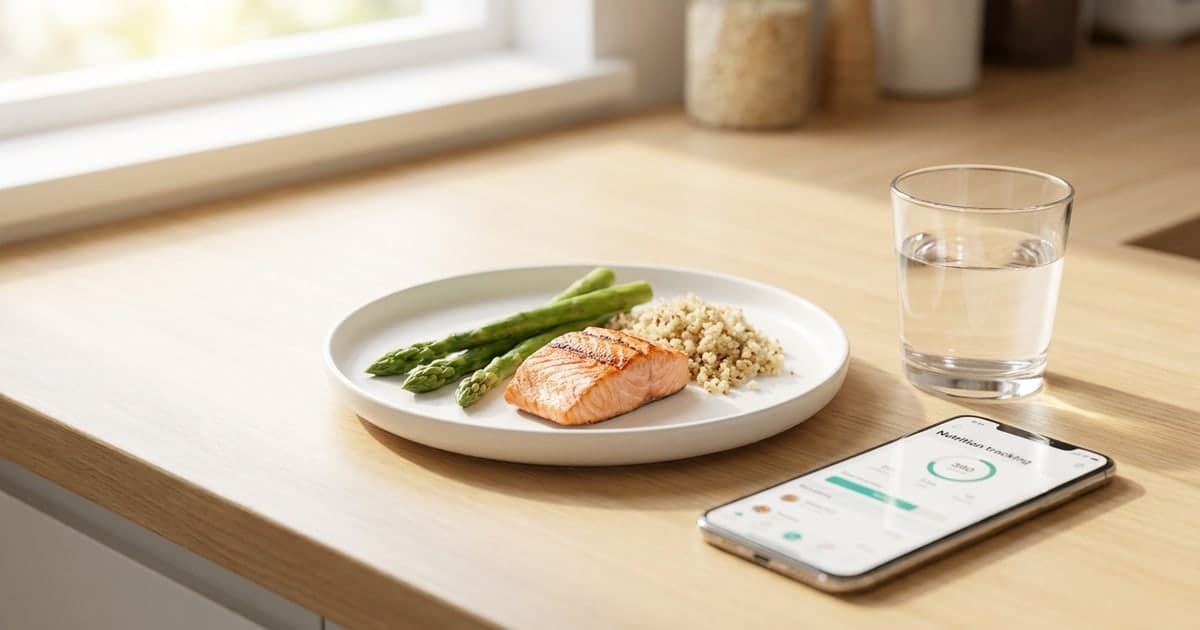
This is also the practical case for tracking. If you are walking deliberately for fat loss, you need to know roughly what you are eating, because the deficit is small enough that two hidden snacks can wipe it out. Snap photos of meals as you eat them. With Calzy, photo recognition lands in about three seconds and gives you a Health Score for the meal — the friction is low enough that you can keep doing it after the novelty wears off. Walking adds the burn. Tracking keeps the burn from being eaten back.
If your scale is not moving despite consistent walking, the answer is almost always in your fork, not your feet. The weight loss plateau breakdown covers what to check first.
Your 4-week build plan
This is the structure I give to anyone starting from scratch.
Week 1 — Measure. Do not change anything. Walk how you normally walk for seven days and look at the average. That is your baseline. Most desk workers land between 3,500 and 5,000 steps. Some land at 1,800. Knowing the number is the only thing that matters this week.
Week 2 — Baseline +1,500. Add roughly 1,500 steps per day on top of your baseline. This is one 15-minute walk. Do it at the same time every day so it becomes automatic — first thing in the morning, lunch break, or right after dinner.
Week 3 — Baseline +2,500. Add another 1,000 steps. You can split it across the day — a morning loop and an evening loop. Or one longer walk. By now, your body has adapted enough that this should feel easy, not punishing.
Week 4 — Hit your target. For most people that is 7,000 steps if they are over 50 or new to exercise, 10,000 if they want to push it. Beyond 10,000, the diminishing-returns curve says you are doing it for the additional calorie burn, not for longevity. Both are valid reasons.
Hold that target for a full month before pushing higher. The point is not to hit a number once. It is to make walking the default — the thing you do without thinking about it.
This week
Three things to do, in order:
- Check your average daily steps from the last 7 days in your phone's health app. This is your real baseline.
- Pick one walk to add every day this week — same time, same length, non-negotiable. Ten minutes after dinner is the easiest entry point.
- Track food honestly for the next 7 days. Not to restrict — to see. If your steps are up but the scale is not, the food data will tell you why immediately.
Walking does not get the Instagram engagement that deadlifts and CrossFit do. It also does not get people injured, exhausted, or quitting. It is the longest game with the shortest learning curve. The best exercise for fat loss is, almost always, the one you will still be doing in five years.
Ready to track smarter?
Snap a photo, get your calories, macros, and Health Score instantly. See what other trackers miss.
Download Calzy — It's Free