Glycemic Index vs Glycemic Load: A Practical Guide to Both
Glycemic index has been on nutrition labels, diet books, and wellness apps for thirty years, but most people who quote it are doing it wrong. They avoid watermelon because the GI is high, then eat a bowl of pasta because the GI is "medium," and end up with worse blood sugar swings than if they had just paid attention to portion size.
The fix is a second metric called glycemic load, which adjusts for how much carbohydrate is actually in a serving. Once you understand both, the practical advice gets a lot simpler and a lot more honest.
What glycemic index actually measures
Glycemic index (GI) is a number from 0 to 100 that tells you how quickly a food raises blood glucose compared to pure glucose, which is set at 100. To measure it, researchers feed a fasted person 50 grams of digestible carbohydrate from the test food and track their blood sugar over two hours.
The classification is:
- Low GI: 55 or below
- Medium GI: 56 to 69
- High GI: 70 and above
This sounds clean, but there's a problem hiding in the methodology. The test always uses 50 grams of carbs, regardless of how much of the food that actually is. For some foods that's a normal portion. For others, it's absurd.
The watermelon problem
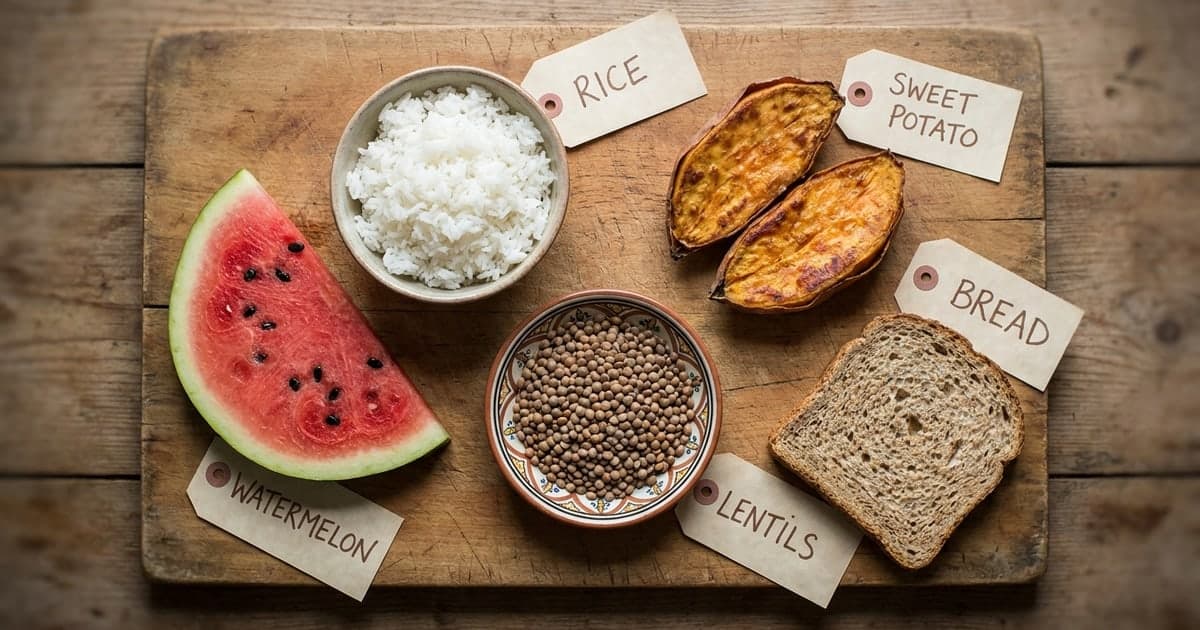
Watermelon has a GI of about 72, which puts it in the high category. Old-school low-GI advice tells you to avoid it. But to get 50 grams of carbs from watermelon, you'd need to eat roughly five cups of cubed fruit in a sitting.
A normal serving of watermelon, around one cup, has only about 11 grams of carbs. The actual blood sugar impact of that serving is tiny. This is exactly the gap that glycemic load was invented to close.
What glycemic load adds
Glycemic load (GL) is a simple calculation:
GL = (GI x grams of carbs per serving) / 100
It scales the GI by how many carbs you're actually eating, which gives you a much more useful number for real meals.
The classification:
- Low GL: 10 or below
- Medium GL: 11 to 19
- High GL: 20 and above
For watermelon, the math is (72 x 11) / 100, which equals about 8. Low GL. The "scary high-GI fruit" is actually a non-event for your blood sugar at normal portions. Meanwhile, a generous serving of white rice can easily exceed a GL of 25 even though its GI is only marginally higher than watermelon's.
If you only memorize one of these two numbers, memorize glycemic load, because it tells you what the food will actually do at the portion you're going to eat.
Common foods ranked by both GI and GL
These values are approximations pulled from international GI databases and published research from roughly 2002 through 2022. Individual responses vary, and the same food can test differently depending on ripeness, processing, and cooking method, but these are reasonable ballparks.
| Food | Typical serving | GI | GL | Practical verdict |
|---|---|---|---|---|
| White bread | 2 slices (60g) | 75 | 22 | High both. Easy to overeat. |
| Whole wheat bread | 2 slices (60g) | 71 | 18 | Better than white only slightly. |
| Sourdough (real) | 2 slices (60g) | 54 | 15 | The fermentation actually lowers GI. |
| White rice (cooked) | 1 cup (160g) | 73 | 29 | High both. Pair with protein and veg. |
| Brown rice (cooked) | 1 cup (160g) | 68 | 22 | Marginal upgrade. Portion still matters. |
| Quinoa (cooked) | 1 cup (185g) | 53 | 13 | Low GI, medium GL. Solid base grain. |
| Rolled oats (cooked) | 1 cup (230g) | 55 | 13 | The everyday champion. |
| Instant oats | 1 packet (40g dry) | 79 | 21 | Big step down from rolled. Avoid. |
| Watermelon | 1 cup (150g) | 72 | 8 | High GI, low GL. Enjoy it. |
| Banana (ripe, spotty) | 1 medium (120g) | 62 | 16 | Medium both. Fine. |
| Banana (green/firm) | 1 medium (120g) | 42 | 11 | Resistant starch drops the GI. |
| Apple | 1 medium (180g) | 36 | 6 | Low both. The default fruit. |
| White potato (hot, boiled) | 1 medium (170g) | 82 | 21 | High both. Worst at peak temperature. |
| White potato (cooked + cooled) | 1 medium (170g) | 56 | 14 | Resistant starch reshuffles the deck. |
| Sweet potato (baked) | 1 medium (150g) | 70 | 22 | Not the magic food it's marketed as. |
| Lentils (cooked) | 1 cup (200g) | 32 | 7 | Low both. Protein and fiber bonus. |
| Chickpeas (cooked) | 1 cup (165g) | 28 | 11 | Low GI, medium GL. Excellent. |
| Table sugar (sucrose) | 1 tablespoon (12g) | 65 | 8 | Surprisingly medium GI. |
| Honey | 1 tablespoon (21g) | 61 | 10 | Basically sugar with extras. |
| Dates (Medjool) | 2 dates (50g) | 42 | 16 | Low GI hides a sneaky-high GL. |
A few things should jump out. Apples beat sweet potatoes. Lentils beat almost everything. Instant oats are essentially a different food from rolled oats. And dates, which get a "healthy" halo in wellness culture, deliver a real carbohydrate punch.
Cooking and storage change everything
This is where most GI tables fall apart in real life, because the same food can land in very different categories depending on what you do to it.
- Pasta cooked al dente has a noticeably lower GI than soft, overcooked pasta. The starch structure holds up better and digests more slowly.
- Potatoes and rice that have been cooked, cooled, and then reheated form resistant starch, which behaves more like fiber than sugar. Cold leftover potato salad is a categorically different food than a freshly boiled potato.
- Banana ripeness matters a lot. A firm green-yellow banana is mostly resistant starch; a brown-spotted one is mostly free sugars.
- Whole vs ground grains. Steel-cut oats digest more slowly than rolled, which digest more slowly than instant. Grinding increases surface area and accelerates absorption.
- Liquid vs solid. Drinking your carbs (juice, smoothies, sweetened coffee) almost always produces a faster blood sugar rise than eating the equivalent food whole.
This is the same reason general carb advice keeps failing people: the cooking method is doing more work than the food label suggests. Two boxes of rice with identical macros on the back can have meaningfully different real-world impacts depending on the variety and how long you cook them.
Why GL is the more useful daily metric
GI tells you the inherent speed-of-spike of a carbohydrate. GL tells you whether that spike matters at the portion you're eating. For day-to-day decisions, GL wins because:
- You eat servings, not 50-gram standardized doses.
- Many "high GI" foods (watermelon, carrots, popcorn) have low GL.
- Many "medium GI" foods (rice, pasta, oatmeal) have high GL because portions are large.
- GL is roughly additive across a meal, so you can estimate the impact of a plate.
The simplest takeaway: a food with a low GL is unlikely to cause meaningful problems, even if its GI is technically high. A food with a high GL will cause a noticeable rise, even if its GI is "medium." Always check the load before adjusting your diet around the index.
Who actually benefits from tracking this
Honest answer: not everyone needs to think about glycemic load.
People who get real, measurable benefit:
- Type 2 diabetics and prediabetics. Lower-GL eating patterns improve fasting glucose and HbA1c in repeated trials.
- People with PCOS. Insulin resistance is the central feature, and GL-conscious eating typically reduces symptoms.
- People with severe insulin resistance independent of formal diagnosis, often signaled by high fasting insulin or persistent abdominal weight gain.
- Endurance athletes, but in the opposite direction. They often want high-GL carbs around training for fast fuel.
For general weight loss, the benefit of low-GL eating is real but modest. Studies consistently show total calorie intake still does most of the work, and the calorie reductions that come from eating slower-digesting carbs are mostly a side effect of feeling fuller for longer. If you want a deeper look at the calorie-quality tension, not all calories are equal covers the nuance.
The CGM trend and what it changed
Continuous glucose monitors went from a diabetes-only device to a mainstream wellness tool between 2024 and 2026, with several over-the-counter options now available without a prescription. They show the curve of your blood sugar in real time.
The most common reaction people have when they start wearing one:
- White rice spikes them harder than they expected.
- "Healthy" smoothies, even all-fruit ones, often produce the biggest spikes of the day.
- Adding protein or fat to a carb meal visibly flattens the curve.
- Walking for ten minutes after eating noticeably reduces the peak.
- Two people eating the same food can have very different responses.
Most of these align with what GI/GL would predict. The genuine new insight is the individual variation. Twin studies and the PREDICT research from 2019 to 2022 showed that two healthy adults can have a 2x to 3x difference in blood sugar response to the same identical meal, driven by genetics, gut microbiome, sleep, and recent activity. If you have access to a CGM, the most useful thing to do with it is identify your personal high-spike foods rather than chase generic advice.
How fat, protein, and fiber change the picture
A banana on its own has a GL around 16. A banana with two tablespoons of peanut butter has roughly the same carb content but produces a meaningfully smaller blood glucose rise, because fat and protein slow stomach emptying and blunt absorption.
The mealtime rules that follow from this:
- Pair fruit with nuts, nut butter, cheese, or Greek yogurt.
- Eat your protein and vegetables before your starch. Order of consumption affects the curve.
- Add olive oil, butter, or avocado to a starch-heavy meal.
- Use vinegar (in dressing) with starchy meals. Trials show modest but real glucose-lowering effects.
- Don't drink calories with a carb-heavy meal if you can avoid it.
This is also where fiber earns its reputation. Soluble fiber, the kind in oats, beans, apples, and chia, forms a gel in the stomach that slows carb absorption. Fiber and weight loss goes into the mechanisms in more detail, and they're the same mechanisms that lower the practical glycemic impact of a meal.
A 5-rule practical framework
If you want to apply GI/GL without becoming the person who pulls out a chart at every meal:
- Build meals around low-GL foundations. Lentils, chickpeas, oats, quinoa, most fruit, most vegetables, dairy. These rarely surprise you.
- Don't fear high-GI foods in moderation. Watermelon is fine. So is a slice of toast, a square of dark chocolate, or a serving of rice with dinner. Single foods rarely make or break a diet.
- Pair carbs with protein and fat. Every starchy meal benefits from a protein anchor. This is one of the highest-leverage habits you can build.
- Cook pasta al dente. Cool your starches if you can. The texture and temperature changes meaningfully lower the GL of foods you were going to eat anyway.
- If you have insulin resistance, take GL seriously. Watch portions of bread, rice, potatoes, and refined grains. Move them from "main event" to "side dish."
You can absolutely lose weight, manage blood sugar, and feel better without ever calculating a glycemic load. The framework above gets you 80% of the benefit just from structural meal habits. If you want to get more analytical, look at the carbohydrate quality part of your nutrition tracking. Calzy's Health Score reflects carb quality (refined versus whole-grain, added sugars, fiber) which correlates with where a food sits on the GI/GL map, even though the app doesn't display GL directly.
What to do this week
Pick one swap and one habit. The swap: replace instant oats with rolled oats, or replace white rice with lentils or quinoa once or twice a week. The habit: pair every fruit you eat with a protein or fat (nuts, yogurt, cheese, nut butter). Two weeks of this beats two months of memorizing glycemic index charts, and it leaves room for watermelon.
Ready to track smarter?
Snap a photo, get your calories, macros, and Health Score instantly. See what other trackers miss.
Download Calzy — It's Free