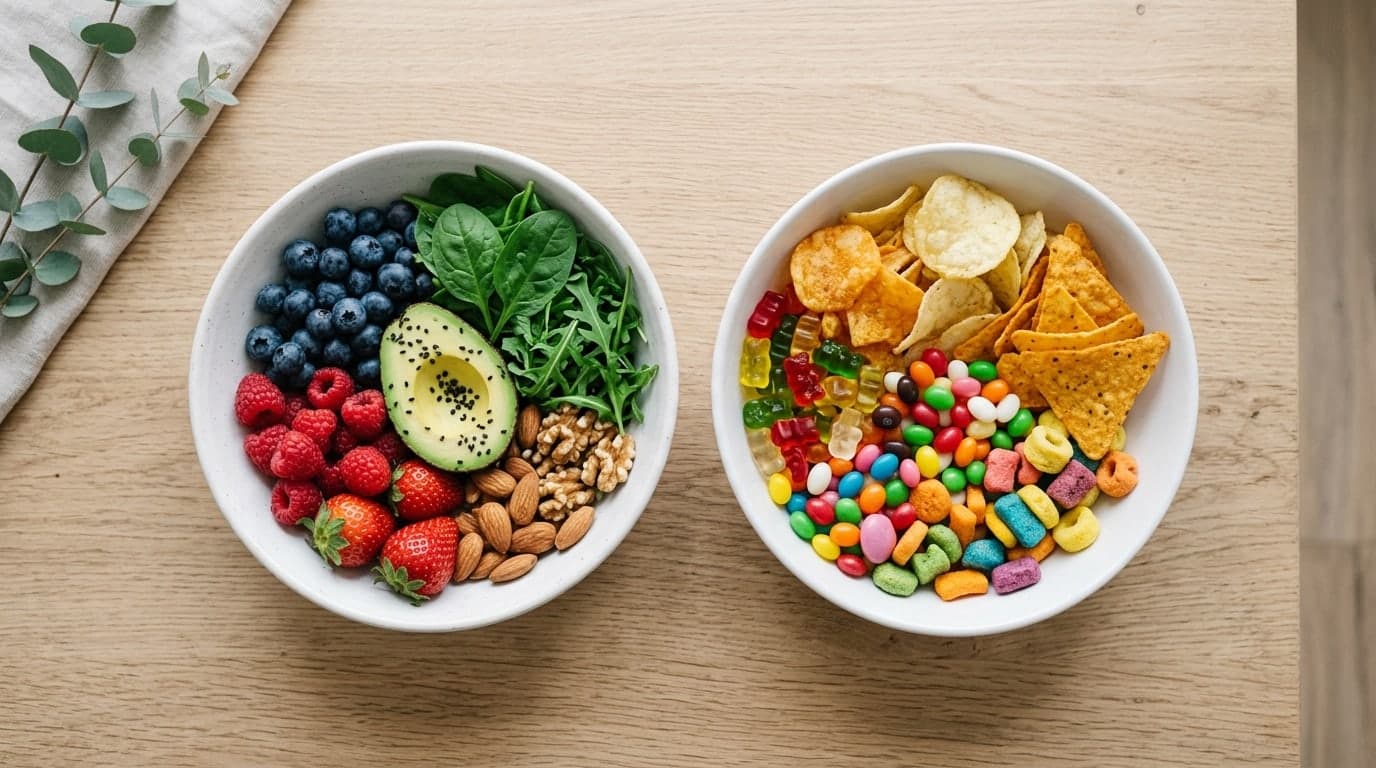
Ultra-Processed Foods Are Sabotaging Your Weight Loss — Here's How
The Diet Paradox Nobody Talks About
You are eating 1500 calories a day. You are in a deficit. You should be losing weight. But the scale is barely moving, and you feel hungrier than ever.
If this sounds familiar, ultra-processed foods might be the hidden variable wrecking your progress. A growing body of research shows that the degree of food processing matters just as much as the calorie count, and possibly more.
This is not about willpower. It is about how certain foods are engineered to make your brain and body work against your goals.
What Are Ultra-Processed Foods? The NOVA Classification
In the early 2000s, Brazilian nutrition researcher Carlos Monteiro developed the NOVA food classification system, which categorizes foods not by their nutrient content but by the extent and purpose of their processing. NOVA divides all foods into four groups:
Group 1: Unprocessed or Minimally Processed Foods
Fresh fruits, vegetables, eggs, meat, fish, milk, nuts, seeds, grains, and legumes. These are foods in their natural state or altered only by drying, grinding, roasting, boiling, or pasteurization.
Group 2: Processed Culinary Ingredients
Oils, butter, sugar, salt, flour, and vinegar. These are substances extracted from Group 1 foods and used in cooking. You rarely eat them on their own.
Group 3: Processed Foods
Foods made by combining Groups 1 and 2 in simple ways — canned vegetables with added salt, cheese, freshly baked bread, cured meats, canned fish in oil. These have been modified but are still recognizable as their original food.
Group 4: Ultra-Processed Foods (UPFs)
This is where it gets concerning. Ultra-processed foods are industrial formulations made mostly or entirely from substances derived from foods, plus additives. They contain ingredients you would never use in a home kitchen: high-fructose corn syrup, hydrogenated oils, protein isolates, emulsifiers, humectants, flavor enhancers, and artificial colors.
Examples include soft drinks, packaged snacks, mass-produced bread, instant noodles, frozen pizza, chicken nuggets, breakfast cereals, energy bars, flavored yogurt, and most fast food.
The key distinction is not how much processing occurs, but what kind. Ultra-processing transforms food into products designed for convenience, long shelf life, and hyper-palatability — often at the expense of nutrition.
The Science: Why UPFs Drive Overeating
The NIH Study That Changed Everything
In 2019, researcher Kevin Hall at the National Institutes of Health published a landmark study that put the UPF debate on firm scientific ground. He recruited 20 adults and housed them in a metabolic ward for four weeks, giving them either an ultra-processed or unprocessed diet for two weeks, then switching.
Both diets were matched for calories, macronutrients, fiber, sugar, and sodium. Participants could eat as much or as little as they wanted.
The results were striking:
- On the ultra-processed diet, people ate an average of 508 more calories per day
- They ate faster, consuming more calories per minute
- They gained about 2 pounds over two weeks
- On the unprocessed diet, they lost about 2 pounds over two weeks
Same people. Same available calories. Same macros. Completely different outcomes based solely on processing level.
Why Does This Happen?
Several mechanisms explain why ultra-processed foods promote overeating:
1. Speed of consumption. UPFs are softer and easier to chew. You eat them faster, and your satiety signals do not have time to kick in before you have already overeaten. Unprocessed foods require more chewing, which slows intake and gives your gut time to communicate fullness to your brain.
2. Disrupted hunger hormones. Ultra-processed diets alter levels of ghrelin (the hunger hormone) and PYY (a satiety hormone) in ways that promote continued eating. In Hall's study, participants on the UPF diet had hormone profiles that favored hunger even after eating.
3. Calorie density without satiety. UPFs pack a lot of calories into a small volume. A 600-calorie muffin disappears in minutes. A 600-calorie meal of chicken, rice, and vegetables takes 20 minutes to eat and fills your stomach much more effectively.
4. Engineered hyper-palatability. Food scientists optimize the combination of sugar, fat, and salt to hit a "bliss point" that maximizes pleasure and cravings. This is not a conspiracy theory — it is standard food industry practice, well documented in books like Salt Sugar Fat by Michael Moss.
5. Gut microbiome disruption. Emerging research suggests that emulsifiers and other UPF additives damage the gut lining and alter the microbiome in ways that promote inflammation, insulin resistance, and fat storage.
The "Healthy" Foods That Are Actually Ultra-Processed
One of the most insidious aspects of ultra-processed foods is how well they disguise themselves as health food. Many products marketed as nutritious are actually NOVA Group 4:
- Protein bars — most contain protein isolates, sugar alcohols, emulsifiers, and artificial flavors
- Flavored yogurt — the fruit-on-the-bottom varieties often contain more sugar than ice cream
- Granola — frequently held together with hydrogenated oils and corn syrup
- Veggie chips — usually potato starch with vegetable powder for color
- Whole wheat bread — mass-produced versions often contain dough conditioners, high-fructose corn syrup, and preservatives
- Smoothie bowls — store-bought versions are often loaded with added sugars and flavor enhancers
- Plant-based meat alternatives — many contain 20+ ingredients including methylcellulose, titanium dioxide, and maltodextrin
The health claims on the front of the package often have nothing to do with the ingredient list on the back.
How to Identify Ultra-Processed Foods
You do not need a nutrition degree to spot UPFs. Here are practical rules that work:
The Ingredient List Test
If the ingredient list contains more than five items, or includes substances you would not find in a home kitchen, it is likely ultra-processed. Look for:
- Ingredients ending in "-ose" (maltose, dextrose, fructose)
- Hydrogenated or partially hydrogenated oils
- Protein isolates or concentrates
- Emulsifiers (lecithin, polysorbate, mono- and diglycerides)
- Flavor enhancers (MSG, yeast extract, "natural flavors")
- Artificial colors (anything with a number after it)
The Fiber-to-Sugar Ratio
For grain-based products, divide the grams of fiber by the grams of sugar. A ratio above 1:1 is good. Ultra-processed grain products almost always have far more sugar than fiber.
The Shelf Life Test
If a product can sit on a shelf for months or years without spoiling, significant processing was required to achieve that. Real food spoils relatively quickly.
The Kitchen Test
Could you make this product at home with ingredients from a regular grocery store? If the answer is no, it is ultra-processed. You can make bread at home. You cannot make a Twinkie at home.
What the Research Shows Long-Term
The evidence against ultra-processed foods extends far beyond weight gain:
- A 2022 meta-analysis of 45 studies found that high UPF consumption was associated with a 29% increased risk of all-cause mortality
- UPF intake is linked to higher rates of type 2 diabetes, cardiovascular disease, depression, and certain cancers
- Each 10% increase in UPF calories is associated with a 12% increase in cancer risk according to a study of over 100,000 French adults
- Countries with the highest UPF consumption (the US, UK, Canada, and Australia) consistently rank highest in obesity rates
Making the Shift Away from UPFs
Eliminating ultra-processed foods entirely is unrealistic for most people, and you do not need to. Reducing UPF intake from the typical 60% of calories to 30% or below can make a significant difference. Here is how to start:
- Swap one UPF per day for a whole food alternative. Replace the protein bar with Greek yogurt and nuts. Replace the flavored oatmeal packet with plain oats topped with real fruit.
- Cook one more meal at home per week than you currently do. Home-cooked food is almost never ultra-processed.
- Shop the perimeter of the grocery store where fresh produce, meat, dairy, and bakery items live.
- Read ingredient lists before nutrition labels. The ingredient list tells you what the food actually is. The nutrition label only tells you what is in it.
- Use tools that track processing level. Calsy uses NOVA classification to show you exactly how processed each meal is, making it easy to see your daily UPF intake at a glance and gradually reduce it.
The Bottom Line
Ultra-processed foods are not just "empty calories." They are actively engineered to make you eat more than you need, disrupt your hormonal satiety signals, and keep you coming back for another serving. Even at a calorie deficit, a diet dominated by UPFs can stall weight loss, increase hunger, and undermine your health.
The most impactful change you can make for weight loss might not be eating less. It might be eating less processed food. When you shift toward whole, minimally processed foods, hunger often decreases naturally, portions self-regulate, and the calorie deficit you are chasing becomes much easier to maintain.
You do not need to be perfect. You just need to know what you are eating. And that starts with understanding how processed it really is.
Ready to track smarter?
Snap a photo, get your calories, macros, and Health Score instantly. See what other trackers miss.
Download Calsy — It's Free