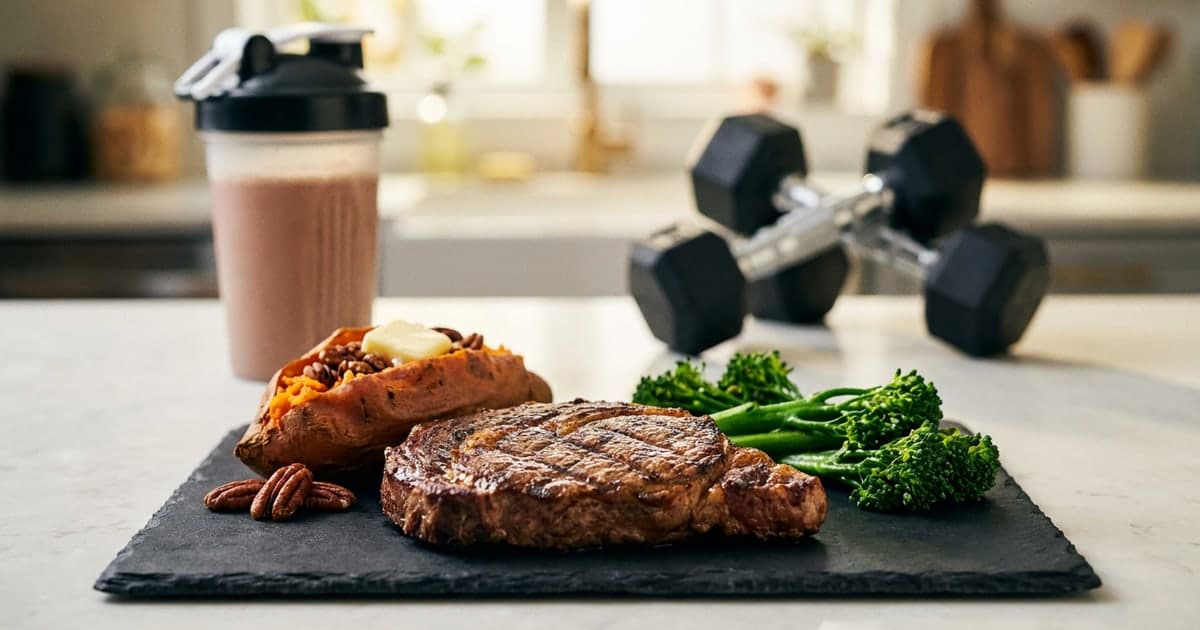
Muscle Gain & Calorie Surplus: A Practical Guide to Bulking
For body composition, muscle gain has been over-romanticized as "eat as much as possible." The current evidence is clear: bigger surplus does not mean more muscle. Past a moderate surplus, almost all extra calories become fat. This is the practical guide to a clean bulk.
The actual rate of muscle gain
The honest numbers, based on training experience:
| Training Year | Realistic muscle gain rate | What that looks like |
|---|---|---|
| Year 1 (beginner) | ~1 kg per month | "Newbie gains" |
| Year 2 | ~0.5 kg per month | Visible progress with consistency |
| Year 3 | ~0.25 kg per month | Slow, deliberate gain |
| Year 4+ | ~0.1 kg per month | Mostly maintenance/recomposition |
| Women | ~50–70% of male rates | Same trajectory, lower magnitude |
These are optimistic rates assuming structured training, sufficient protein, and appropriate sleep.
The implication: a year-3 lifter gaining 0.25 kg of muscle per month doesn't need a 1,000-kcal surplus to do it. They need ~150 kcal/day extra plus the right training. Beyond that, the surplus is fat.
How big should the surplus be?
The general rule based on current research:
- Beginner (year 1): TDEE + 250 to 400 kcal/day. Aim for 0.5 kg/month weight gain.
- Intermediate (year 2): TDEE + 150 to 250 kcal/day. Aim for 0.3 kg/month weight gain.
- Advanced (year 3+): TDEE + 100 to 200 kcal/day. Aim for 0.1–0.2 kg/month weight gain.
Anything above that is "dirty bulk" territory — you're gaining fat that you'll have to cut later. The cycle of bulk and cut nets out poorly when the bulk is aggressive.
Why slow bulks beat fast bulks
- Muscle protein synthesis is rate-limited. You can only build so much muscle in a week. Excess calories don't accelerate the rate.
- Fat gain is calorie-driven. Anything beyond what muscle synthesis can use becomes fat.
- Insulin sensitivity drops with body fat. As you bulk, your ability to partition calories toward muscle vs fat declines. Stay leaner; gain better.
- The "bulk → cut → bulk" cycle wastes time. A year of slow lean bulk + 6 weeks of mini-cut produces better composition than 6 months of dirty bulk + 6 months of cut.
Protein for muscle gain
The protein target for hypertrophy:
- 2.0–2.2 g per kg body weight per day during a surplus.
- For a 75 kg lifter: 150–165 g protein/day.
- Distribute across 4 meals: ~40 g per meal hits the leucine threshold and saturates muscle protein synthesis.
You don't need more than 2.2 g/kg. There's no additional benefit. The "the more protein, the more muscle" idea is wrong above this threshold.
Carbs and fat in a surplus
Once protein is set, carbs and fat fill the rest. A reasonable starting point:
- Carbs: 4–6 g per kg body weight (300–450 g/day for a 75 kg lifter)
- Fat: 0.8–1.2 g per kg body weight (60–90 g/day)
Carbs are the priority macro for hypertrophy (after protein) because:
- They fuel high-volume training.
- They replenish glycogen, which is needed for the next session.
- They drive insulin response, which is anabolic in a training context.
Low-carb bulks can work but are needlessly hard. Default to a moderate-to-high carb intake.
Training is the actual driver
Calories support muscle growth, but training causes it. The framework that works:
- 3–5 strength sessions per week of 45–75 minutes each.
- Compound movements as the foundation: squats, deadlifts, bench, rows, overhead press.
- Progressive overload — add weight, reps, or sets over time. The training has to get harder.
- 10–20 hard sets per muscle group per week — distributed across sessions.
- Reps mostly in the 5–12 range; some 12–20 for higher-rep work.
- Train close to failure on most sets — within 2–3 reps of failure.
Without that training stimulus, a calorie surplus produces fat gain only. With it, the surplus supports the muscle growth your training is requesting.
What "bulking food" actually looks like
The myth: you eat enormous quantities of meat and rice. The reality: most lifters in a moderate surplus eat ~300–500 calories more than they did at maintenance. That's:
- An extra cup of rice at dinner
- An extra protein shake mid-morning
- An extra spoonful of peanut butter
That's it. The "bulk meals" you see on YouTube — 4,000-calorie days, 8 eggs at breakfast — are exaggerated for content. Most natural lifters eat fewer calories than people think.
Sample 75 kg lifter, intermediate, 300-kcal surplus:
| Meal | Foods | Calories | Protein |
|---|---|---|---|
| Breakfast | 4 whole eggs + 1 cup oats + 1 banana + 1 tbsp peanut butter | 700 | 35 g |
| Lunch | 200 g chicken breast + 200 g rice + vegetables + 1 tbsp olive oil | 750 | 60 g |
| Pre-workout | Greek yogurt + berries + honey | 250 | 18 g |
| Dinner | 200 g salmon + 200 g sweet potato + vegetables | 600 | 45 g |
| Snack | 1 scoop whey + milk | 250 | 30 g |
Total: 2,550 kcal, 188 g protein. TDEE for a 75 kg moderately-active lifter is ~2,250; surplus of 300 kcal/day is appropriate for ~0.3 kg/month gain.
How to measure progress
The scale alone is not enough. Monitor weekly:
- Body weight (daily average over the week)
- Strength on key lifts — should trend up in 2–4 week cycles
- Waist circumference — if waist grows faster than weight, surplus is too high
- Photos — one weekly photo, same conditions, to visually track composition
- Sleep and recovery — overshooting energy intake can disrupt sleep
If body weight is rising but key lifts aren't, you're gaining fat without strength. Cut surplus by 100–200 kcal.
If weight is stable for 2–3 weeks, increase surplus by 100–200 kcal.
If waist circumference rises faster than other measurements, drop surplus or move to maintenance.
When to switch to a cut
A bulk should end when:
- Body fat reaches a level you don't want to exceed (typically 18–20% for men, 25–28% for women).
- You're noticing aesthetic changes you don't like.
- Lifting is being limited by the extra weight (rare in moderate surpluses).
A reasonable bulk-to-cut ratio for natural lifters: 6 months bulk, 8–12 weeks cut. The cuts don't need to be extended; the goal is to take 4–5 percent off body fat and re-enter the bulk leaner.
What to do this week
- Calculate maintenance (TDEE).
- Add 200–400 kcal based on training experience.
- Set protein at 2.0–2.2 g/kg.
- Track for 4 weeks, then assess weight, strength, waist.
- Adjust calories ±100–200 based on the trend.
Lean bulks are the underrated approach. They don't go viral on social media because they're slow and quiet. They also produce most of the actual muscle gain you see in real lifters. Skip the dirty bulk; eat 300 calories above maintenance, train hard, and let time do the work.
Ready to track smarter?
Snap a photo, get your calories, macros, and Health Score instantly. See what other trackers miss.
Download Calsy — It's Free