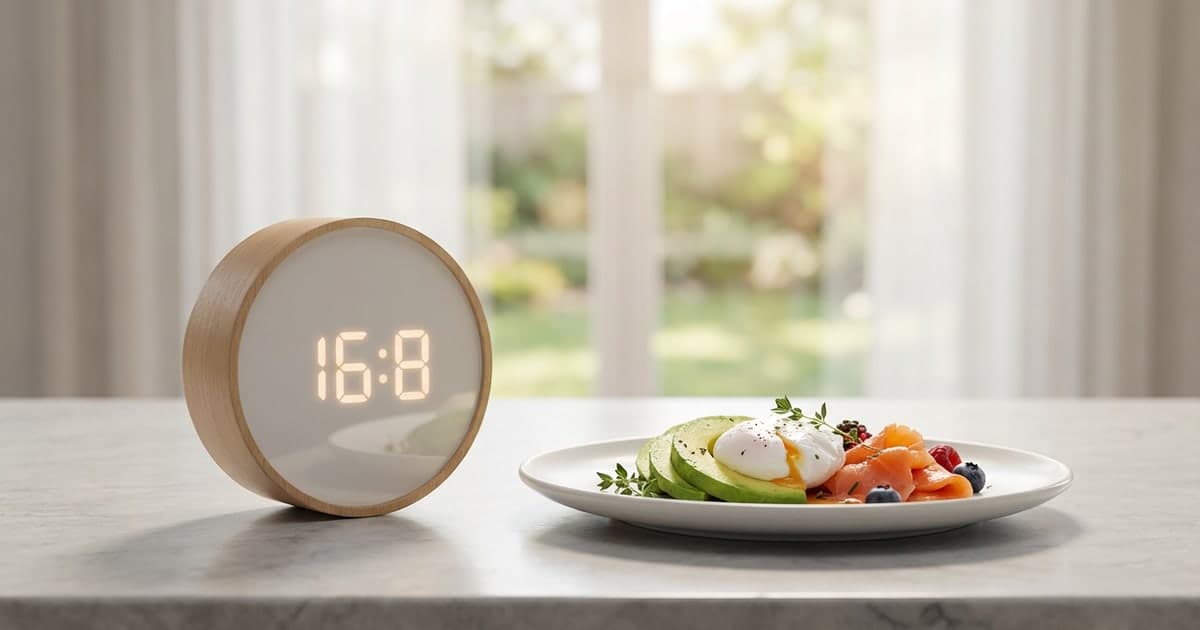
Intermittent Fasting + Calorie Counting: Do You Need Both?
Intermittent fasting (IF) is the most popular diet pattern of the last decade. Calorie counting is the most evidence-backed weight-loss strategy of the last 50 years. Many people pick one or the other; many ask whether they should combine them. Below is the honest answer.
What IF actually does
The popular claims about IF — that it triggers special "fat-burning mode," boosts metabolism, autophagy in the average person — are mostly overstated.
What IF does do, reliably:
- Compresses your eating window, which usually reduces calorie intake even without conscious tracking.
- Eliminates one or more meals, removing easy snacking and incidental calories.
- Simplifies decisions — fewer meals to plan, fewer choices to make.
That's it. The mechanism behind IF's weight-loss results is, in almost all controlled studies, a calorie deficit caused by eating less in a smaller window. Not metabolic magic.
The big trial that settled the metabolic question
A 2022 randomized controlled trial published in NEJM compared:
- Group A: 16:8 IF + calorie restriction
- Group B: calorie restriction alone (matched calories, no fasting window)
Result: identical weight loss, body composition, and metabolic markers at 12 months. The IF protocol added no advantage when calories were matched.
That's the cleanest evidence we have. It says: IF works because it makes you eat less. If you control calories without IF, you get the same outcome.
When IF is the right tool
IF is genuinely useful for some patterns of life:
1. You graze and don't realize it
Some people consume 500–700 calories per day through "tasting while cooking," picking off plates, snacks at work, the bowl of nuts on the counter. They don't register these as meals.
IF — particularly 16:8 with eating between, say, 12 p.m. and 8 p.m. — eliminates this entire category. You don't eat outside the window, period. No tracking, no decision-making. The grazing problem disappears.
2. You want fewer meals to plan
Going from 4 meals/day to 2 meals/day cuts decision fatigue in half. For some people this is a quality-of-life win; for others, it's miserable.
3. Breakfast doesn't appeal to you
If you're not hungry in the morning, IF is the formal version of what your body already wants. Skip breakfast, eat a real lunch and dinner, done.
4. You're metabolically healthy but want simplification
For weight maintenance, IF works as a low-cognitive-overhead pattern. Eat real food in your window; don't eat outside it. Done.
When IF is the wrong tool
1. You train hard
Compressing eating windows can make hitting protein targets and pre/post-workout fueling difficult. Strength athletes, endurance athletes, and anyone training 5+ times per week generally do worse on IF than on regular meal patterns.
2. You have a history of disordered eating
Restrictive eating windows can trigger or reinforce unhealthy patterns. If you've had eating disorders, IF is high risk and worth avoiding.
3. You're a woman with menstrual or hormonal sensitivity
Some women experience cycle irregularities or hormonal symptoms on aggressive IF protocols (16:8 daily, 18:6, 20:4). The mechanism likely involves stress hormone elevation. If you notice cycle changes, IF probably isn't right for you.
4. You compensate during the eating window
The most common IF failure mode: skip breakfast, then eat 2,500 calories between noon and 8 p.m. The fasting window did nothing because the eating window made up for it. You're at maintenance or surplus, fasting or not.
If you can't trust yourself to not compensate during the eating window, IF without tracking doesn't work — and IF with tracking is just calorie counting with extra steps.
When to combine IF + calorie counting
There's exactly one case where combining both clearly helps: if you find IF's structure makes calorie counting easier.
For some people, having only 2 meals to log is much simpler than logging 4–5 meals. The combined approach removes friction and improves compliance.
For others, IF makes them obsess about both the window and the calories — twice the cognitive overhead. If that's you, pick one.
Practical IF protocols, ranked
If you decide IF is right for you, the cleaner protocols:
16:8 (most common)
Eat between (e.g.) 12 p.m. and 8 p.m. Fast for 16 hours including overnight. Easy entry, mild restriction, sustainable for years.
14:10 (gentler)
Eat between 10 a.m. and 8 p.m. Most people are technically already doing this; formalizing it tightens the window slightly.
5:2
Five days of normal eating + 2 non-consecutive days at ~500–600 calories. Useful for people who hate daily restriction but can do two structured cut days per week.
One Meal a Day (OMAD) / 23:1
Aggressive, uncomfortable, hard to hit protein and micronutrients. Not recommended unless you've tested gentler windows first and have specific reasons to compress further.
Alternate-day fasting
Alternating ~500 kcal days with ~2,000 kcal days. Effective in trials, low compliance long term.
How to combine IF and calorie counting cleanly
If you decide to do both:
- Set your calorie target first — TDEE − 300–500 kcal.
- Set your eating window — 16:8 is the default starting point.
- Hit your protein target inside the window — 1.6–2.2 g/kg body weight, distributed across 2 meals.
- Photograph your meals — easier than searching databases when you're eating in a compressed window.
- Don't compensate. The point is to eat less; if your 2 meals add up to your old 4 meals' calories, you've gained nothing.
The bottom line
IF is a calorie-restriction tool. It's not a metabolic switch. If you like the structure — eat in a window, don't eat outside it — and it makes you naturally eat less, it works. If you don't like it, don't do it; you can hit the same calorie target on any meal pattern.
If you already calorie count successfully, IF doesn't add anything. If you can't bring yourself to track calories but you can stop eating after 8 p.m., IF is doing the calorie work for you, and that's fine.
The two tools serve the same goal — control of energy intake. Pick whichever you'll actually do.
What to do this week
- If you eat past 8 p.m. regularly: try a 16:8 window for 7 days, no other changes. See what happens to your weight and hunger.
- If you already calorie count: don't add IF unless it makes counting easier. You're already getting the benefit.
- If you train 5+ times per week: stick with regular meal patterns. The IF compromise on training quality usually isn't worth it.
The honest answer to "do I need both?" is: pick the one you'll actually do for 12+ weeks. That's the version that works.
Ready to track smarter?
Snap a photo, get your calories, macros, and Health Score instantly. See what other trackers miss.
Download Calsy — It's Free